



Bitcoin didn’t climb out of its August slump quietly. It got shoved out by one of the most violent short squeezes in recent memory — and now the real test begins.
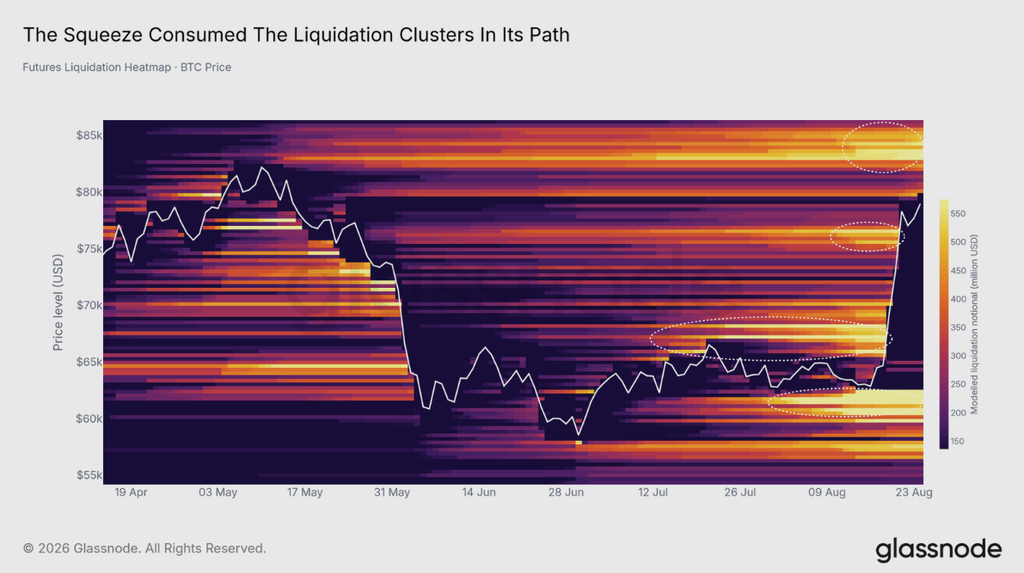
According to Glassnode’s latest weekly on-chain report, August 19 produced the largest single-day short liquidation event the firm has tracked since 2019. Roughly 85% of everything wiped out during the move was short positions, and that’s likely an undercount since Glassnode’s data doesn’t include Hyperliquid volume. The forced buying from that flush helped power a 26% rally off Bitcoin’s mid-August lows — but it also burned through nearly every liquidation cluster sitting in its path, clearing out 86% of the modeled fuel along the way.
What’s left is a battle line. A dense pocket of short liquidation levels still sits at $82K-$86K just overhead, while a smaller band of long liquidation risk lingers below at $60.5K-$62.4K.
The Rally Wasn’t Just Leverage — Real Money Showed Up
Here’s what separates this move from a typical leverage-driven pump: it deleveraged the market instead of re-loading it. Futures open interest, measured in coin terms, actually shrank 11% during the squeeze window. Funding rates barely budged off neutral and even dipped negative afterward — a sign that traders weren’t chasing the rally with fresh long bets. This was a stop-hunt, not a mania.
Instead, spot demand did the heavy lifting. US spot Bitcoin ETFs pulled in $2.23 billion over the squeeze window without a single day of outflows — the strongest weekly intake so far this year, including the largest single-day creation since mid-January.
The coin flows back that up. Since late June, mid-sized holders (1,000-10,000 BTC) have offloaded roughly 50,500 BTC, while the largest wallets — mostly exchanges, custodians, and ETF vehicles — absorbed about 59,100 BTC over the same period. During the squeeze week alone, that custody bucket picked up 31,500 BTC, a figure that lines up closely with the scale of ETF creations over the same stretch. Coins are moving off whale balance sheets and onto institutional rails.
Accumulation isn’t limited to the big players, either. Every wallet-size cohort Glassnode tracks — from shrimp to whales — has held an Accumulation Trend Score at or above the neutral 0.5 mark for 20 straight days, the longest stretch of broad-based buying since a similar run in late 2024.
A Rally That Ignored the Stock Market
One of the stranger wrinkles in this move: it happened while equities were falling. Bitcoin gained 25% during the squeeze window while the S&P 500 slipped 1.7%, and the rolling correlation between the two assets collapsed toward zero. That link has snapped back before — it happened twice in 2025 — so it’s too early to call this a permanent decoupling. But for now, Bitcoin’s rally clearly isn’t riding on stock market momentum. It’s running on its own fuel.
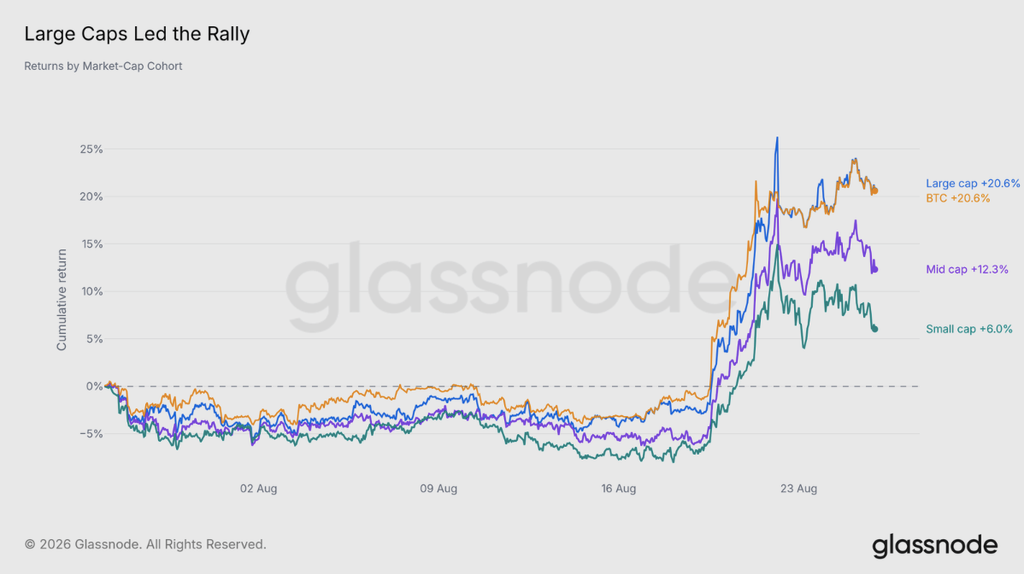
The advance has also been top-heavy. Large-cap crypto assets returned 20.6% over the past month, matching Bitcoin’s own performance, while small-cap tokens managed just 6%. That’s typical of early-stage recoveries, when capital gravitates toward the most liquid names first. Broader participation from smaller assets would be a healthy next signal — it just hasn’t arrived yet.
Every Wall Points to the Same Zone: $81K-$86K
This is where things get interesting. Glassnode’s report stacks up multiple independent layers of resistance, and they all converge in almost the exact same price band. Long-term holder cost-basis supply sits heavy at $83K-$86K — effectively coins held through the entire drawdown that are now sitting near breakeven. Self-custody wallets show a cost-basis shelf starting at $80.8K. Options dealers’ gamma flips negative at $82.3K. And the surviving liquidation cluster from the squeeze runs up to $86K.
Order book data reinforces the picture: resting sell orders in the zone just above spot price jumped 41% in the final days of the window, while bids across the broader book thinned by nearly a third. Sellers are positioning themselves to defend that ceiling.
Options traders seem to agree the rally will pause here rather than break through immediately. The two largest upcoming options expiries both carry their “max pain” price — where the most contracts expire worthless — well below current spot, around $69K-$70K. The broader forward-looking distribution for late September is wide and centered near current price, suggesting the market expects consolidation rather than a fast breakout or breakdown.
Also Read: Strategy Would Survive a 96% Bitcoin Crash. This Is What Could Actually Break It – Report
The Bottom Line
Bitcoin’s rebound was lit by a historic short squeeze, then sustained by genuine institutional demand — not leverage. That’s a healthier setup than most V-shaped bounces. But the coming weeks hinge on one number: can buyers push through the $81K-$86K wall, or does price fall back toward the $70K cost-basis line and, eventually, the $62K-$65K floor that funded this entire move? For now, the market is holding its breath right in the middle.
Disclaimer: The information in this article is for general purposes only and does not constitute financial advice. The author’s views are personal and may not reflect the views of chainrant.com. Before making any investment decisions, you should always conduct your own research. chainrant.com/ is not responsible for any financial losses.




1 Pingback