How Crypto Liquidations Work: Why One Candle Can Wipe Out $1 Billion

- A liquidation is a forced closure of a leveraged trade when the margin can no longer cover losses.
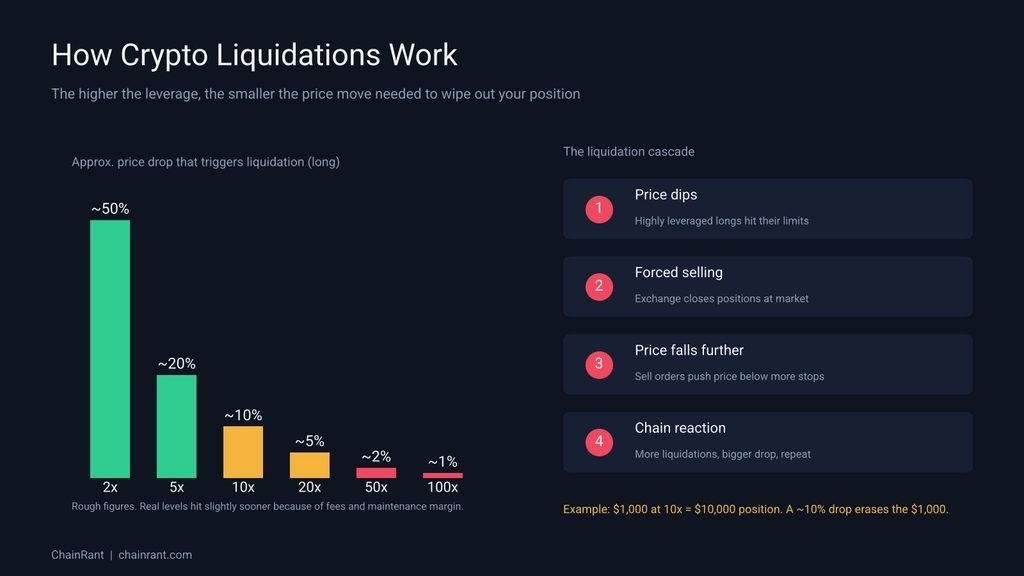
- Roughly, a trade at Nx leverage is wiped out by a price move of about 100/N percent against it.
- Cascades make crashes sharper, because forced selling pushes prices down and triggers more liquidations.
Every crypto crash comes with the same headline number: liquidations. When bitcoin dropped to $55,130 this month, about $1.8 billion in leveraged positions were wiped out in a single selloff, roughly $1.3 billion of them bets on rising prices. If that figure left you wondering what exactly got “liquidated,” this guide explains it from the ground up.
What Is a Liquidation?
A liquidation happens when an exchange forcibly closes a leveraged trade because the trader no longer has enough money backing it. Traders put up their own money, called margin, and borrow the rest to take a bigger position. If the market moves against them and the margin can’t cover the losses, the exchange steps in and closes the trade automatically. The trader doesn’t get a say, and the margin is usually lost.
The Math Behind It
Leverage multiplies both gains and losses. Say you deposit $1,000 and open a 10x long, which controls a $10,000 position. If bitcoin rises 5%, you make $500, a 50% return on your deposit. If it falls about 10%, your $1,000 is gone. Because of fees and maintenance margin requirements, the exchange usually liquidates you slightly before that point.
The rule of thumb: divide 100 by your leverage to estimate how far the price can move against you. At 2x, you can survive a drop of roughly 50%. At 20x, about 5%. At 100x, around 1%. In a market where bitcoin can move several percent in an hour, high leverage is a short fuse.
Why Liquidations Snowball
The real danger isn’t one trader getting wiped out. It’s the chain reaction. When an exchange liquidates a long position, it sells that position into the market. That selling pushes the price lower, which pushes other traders’ positions past their limits, which triggers more forced selling. Analysts call this a liquidation cascade, and it explains why crypto prices can fall far faster than the news justifies.
Cascades are worst when leverage is crowded into a narrow price zone. Data providers such as Glassnode and CoinGlass map these clusters, and prices often get pulled toward them. This month, a large cluster of long positions between $59,000 and $62,000 had built up, and once the price slid through it, the selling fed on itself. Liquidations can also work in reverse. When prices rise sharply, shorts get forced to buy back, creating a “short squeeze.”
Also Read: Crypto Has Crossed a Threshold — and the Rules Are Finally Catching Up
Isolated vs. Cross Margin
Most exchanges offer two modes. In isolated margin, only the money assigned to that trade is at risk. In cross margin, your whole account balance backs the position, which delays liquidation but can drain everything you have on the exchange. Many beginners choose cross margin without realizing a single bad trade can take their entire balance.
What Liquidation Data Can (and Can’t) Tell You
Large liquidation numbers often show up near turning points, because forced sellers leave the market and the selling pressure fades. That’s why traders watch them as a sentiment signal, and why a flush is sometimes followed by a bounce, as bitcoin’s 9% rebound off its low showed. But a liquidation spike is not a reliable buy signal. Prices can keep falling after the first wave, especially when other pressures such as ETF outflows or interest-rate fears remain.
How Traders Protect Themselves
There’s no way to remove the risk, but these habits reduce it:
- Use low leverage. Many experienced traders stay at 3x or below.
- Keep margin buffers. Don’t open a position with the minimum collateral.
- Set stop-losses. A stop you choose beats a liquidation you don’t.
- Avoid crowded levels. Be careful near round numbers and known liquidation clusters.
- Size positions small. Risk only what you can afford to lose entirely.
The Bottom Line
Liquidations are the price of easy leverage. They’re the engine behind the sharpest crypto crashes and squeezes, and they explain why a market can lose billions in hours. Understand how they work before using leverage, and the next big liquidation headline will make a lot more sense.
This article is for education only and is not financial advice. Leveraged trading carries a high risk of loss.