



Two years ago, cryptocurrency’s mainstream moment felt perpetually one cycle away. Today, that argument is over. What began with bitcoin breaking $100,000 in late 2024 has evolved into something more durable: a financial system that is quietly, structurally absorbing digital assets — not just tolerating them.
In 2026, the story isn’t just price. It’s regulation, corporate balance sheets, and the plumbing of global payments being rewired in real time.
Bitcoin on Corporate Balance Sheets: The New Treasury Playbook
Bitcoin currently trades roughly 50% below its October 2025 peak of $126,200 , yet remarkably, institutional commitment hasn’t faded — it has deepened. Aggregate net inflows into bitcoin ETFs since January 2024 have exceeded $57 billion, with total assets under management approaching $130 billion. BlackRock’s IBIT reached $67 billion in AUM in under a year.
The ETF story, however, is no longer even the most striking development. Public companies now collectively hold over 1.7 million BTC, representing approximately 8% of total supply. In several quarters of 2025, corporate purchases exceeded ETF inflows. Companies are no longer dipping a toe in — they are treating bitcoin as a strategic reserve asset. The introduction of fair-value accounting treatment removes a long-standing balance-sheet penalty and allows companies to recognise gains rather than only impairments.

According to Coinbase Institutional, 76% of global investors planned to expand digital asset exposure in 2026, with nearly 60% expecting to allocate over 5% of their assets under management to crypto. B2broker That is not a fringe position anymore — it is edging toward consensus.
Price forecasts for bitcoin in 2026 remain wide, reflecting genuine uncertainty. Major bank and analyst targets range from around $75,000 to $250,000, with many clustering in the low-to-mid six figures. Standard Chartered cut its 2026 forecast to $150,000 in December 2025, down from a previous $300,000 target. Bloomberg ETF analyst Eric Balchunas estimated a base case of roughly $15 billion in crypto ETF inflows for 2026, with upside scenarios reaching $40 billion if market conditions improve. The range is wide, but the directional conviction is broadly bullish.
Stablecoins Get a Legal Framework — and a $260 Billion Market to Match
Stablecoins were already the quiet backbone of crypto. In 2025, they became something else: federally regulated infrastructure. Total stablecoin market capitalisation surpassed $260 billion by mid-2025, up from $20 billion in 2020, with transaction volumes outpacing those of Visa and Mastercard combined.
The legislation that formalises this reality is the GENIUS Act. On July 17, 2025, the U.S. House of Representatives passed the Guiding and Establishing National Innovation for U.S. Stablecoins Act, which creates a comprehensive federal framework for the issuance and regulation of stablecoins. The Act requires 100% reserves and implements disclosure requirements similar to those in traditional banking. Federal Reserve Bank of Richmond Treasury licensing applications open in Q3 2026, putting compliance timelines into motion for issuers of all sizes.
With compliance guardrails now in place, enterprise integration has picked up pace. Over a dozen global banks and fintechs — including JPMorgan, Bank of America, and Citigroup — have filed for licenses or announced upcoming stablecoin launches. These institutions aren’t experimenting. They are building payments infrastructure.
The GENIUS Act joins regional frameworks including the EU’s MiCA and Singapore’s MAS stablecoin regime in creating structured, scalable environments for institutional participation. For the first time, stablecoin issuers globally are operating within a patchwork of real legal standards — not a regulatory void.
The real-world implications are clearest in emerging markets. In countries where local currencies lose value rapidly, dollar-pegged tokens remain a lifeline for millions of people who cannot access traditional banking. Coinbase’s 2026 Crypto Market Outlook forecasts stablecoin market cap could reach a target range centered around $1.2 trillion by the end of 2028, driven by newer use cases in cross-border transaction settlement, remittances, and payroll platforms. Coinbase
Tokenization Moves From Experiment to Infrastructure
Real-world asset tokenization — the process of representing ownership of conventional assets as blockchain tokens — has quietly crossed into production. Tokenized assets crossed $30 billion in the third quarter of 2025, driven by private credit at approximately $17 billion and U.S. Treasuries at roughly $7.3 billion. That figure represents a roughly tenfold increase from 2022 levels.
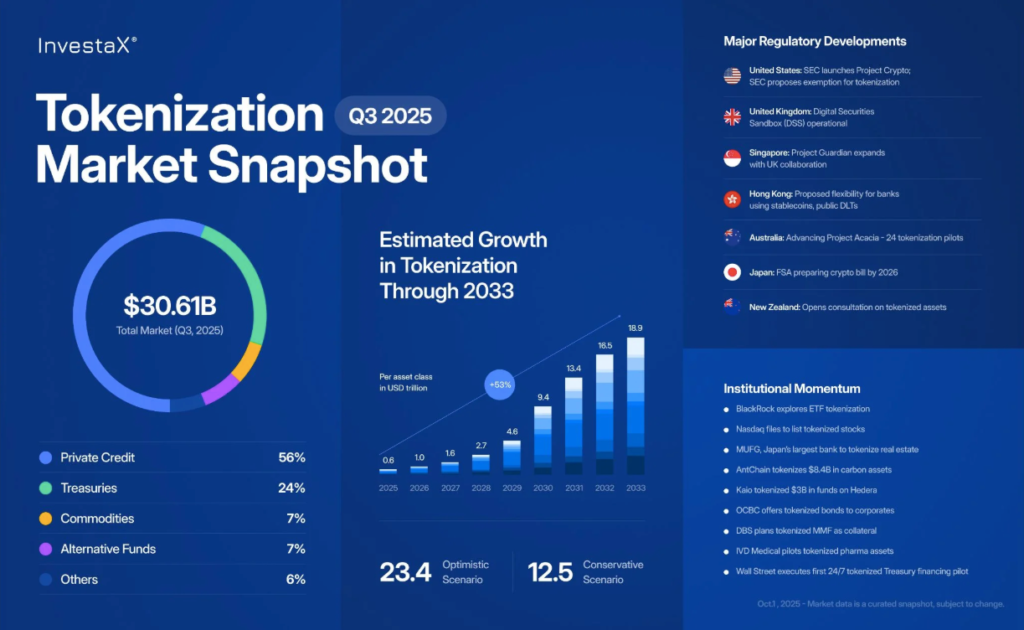
The institutional roster building in this space reads like a financial establishment roll call. Robinhood launched tokenized equities, Stripe developed stablecoin infrastructure, and JPMorgan moved to tokenize deposits. Goldman Sachs and BNY Mellon issued tokenized money market funds, while Binance adopted tokenized Treasuries for off-exchange settlement.
Experts forecast the RWA sector will reach $600 billion by 2030 and potentially $30 trillion by decade’s end. The current base is still narrow — most projects remain concentrated in fixed income and private credit rather than more complex asset classes — but the infrastructure being built now is designed for much broader scope.
Regulation Is No Longer the Enemy — It’s the Catalyst
For most of crypto’s history, regulatory action was viewed as an existential threat to the industry. In 2026, the relationship has inverted. For most of crypto’s history, regulation was viewed as an existential threat. In 2026, it has become the primary growth catalyst.
Grayscale expects bipartisan crypto market structure legislation to become U.S. law in 2026, which will bring deeper integration between public blockchains and traditional finance, facilitate regulated trading of digital asset securities, and potentially allow for on-chain issuance by both startups and mature companies.
The U.S. Office of the Comptroller of the Currency has granted conditional approval for five national trust bank charters tied to digital assets — covering BitGo, Circle, Fidelity Digital Assets, Paxos, and Ripple — moving stablecoin and custody infrastructure inside the federal banking perimeter.
Also Read: Chainalysis: The $1.5 Quadrillion Stablecoin Era Is Closer Than You Think — Here’s Why?
That doesn’t mean risk has evaporated. Bitcoin’s pullback from its October 2025 high demonstrates that volatility hasn’t been engineered out of the market. Geopolitical shocks, liquidity tightening, and macro uncertainty all still move prices dramatically. Among professional investment managers, 67% still report zero exposure to digital assets , per a Bank of America institutional survey — a figure that highlights just how much runway adoption still has, and how much education and infrastructure building remains.
The defining question for 2026 isn’t whether crypto belongs in the financial system. That debate ended. The question now is how quickly the compliance, custody, and settlement infrastructure scales to meet the institutional demand already waiting on the other side.
Disclaimer: The information in this article is for general purposes only and does not constitute financial advice. The author's views are personal and may not reflect the views of chainrant.com/. Before making any investment decisions, you should always conduct your own research. chainrant.com/ is not responsible for any financial losses.