

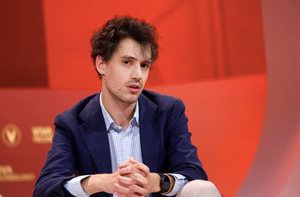

Cardano founder Charles Hoskinson believes Bitcoin’s long-term dominance could be at risk if the network fails to adapt to the emerging challenge of quantum computing.
Speaking on The Starting Block, Hoskinson argued that Bitcoin’s biggest obstacle is not its technology but its governance. While Bitcoin has survived numerous challenges since its launch, he said future threats may require coordinated protocol upgrades that are difficult to achieve under the network’s current decision-making structure.
His comments come as debate over quantum computing’s potential impact on blockchain security continues to grow across the cryptocurrency industry.
Hoskinson Says Governance Could Determine Bitcoin’s Future
According to Hoskinson, Bitcoin has proven remarkably resilient throughout its history, including after the disappearance of its creator, Satoshi Nakamoto.
However, he believes quantum computing presents a different type of challenge. If future advances weaken today’s cryptographic standards, Bitcoin would likely require a network-wide migration to quantum-resistant security.
Hoskinson argued that Bitcoin’s decentralized governance model could make implementing such sweeping changes more difficult than on blockchains with formal governance systems.
Despite the concerns, Bitcoin remains the world’s largest cryptocurrency, with a market capitalization of approximately $1.28 trillion.
Cardano Positions Itself for Future Upgrades
Hoskinson said Cardano was designed to preserve Bitcoin’s original vision while overcoming governance and scalability limitations that have emerged over time.
He pointed to Cardano’s on-chain governance framework as a key advantage. Under the system, stakeholders can vote on protocol upgrades, allowing the network to coordinate major technical changes more efficiently if quantum-resistant infrastructure becomes necessary.
In his view, this governance model gives Cardano greater flexibility to respond to evolving technological challenges.
Leios Upgrade Targets Major Performance Gains
Hoskinson also discussed Cardano’s development roadmap, highlighting the upcoming Ouroboros Leios upgrade.
The next-generation scaling protocol is expected to improve network performance by as much as 60 times, according to Hoskinson. Development has continued with the launch of the Musashi Dojo testnet, while the recently activated van Rossem hard fork (Protocol Version 11) established the technical foundation for Leios ahead of its planned mainnet release later this year.
A New Approach to Bringing Bitcoin Into Cardano
Beyond scalability, Hoskinson outlined a proposal for integrating Bitcoin liquidity into Cardano without relying on conventional cross-chain bridges.
Because both networks use the Unspent Transaction Output (UTXO) model, he suggested developers could use zero-knowledge cryptography to create a non-custodial representation of Bitcoin on Cardano.
Under this design, users would retain ownership of their BTC while accessing Cardano-based decentralized applications, avoiding third-party custody and reducing the security risks commonly associated with blockchain bridges. Hoskinson added that the approach could also avoid taxable events because users would continue holding their original Bitcoin rather than exchanging it for a new asset.