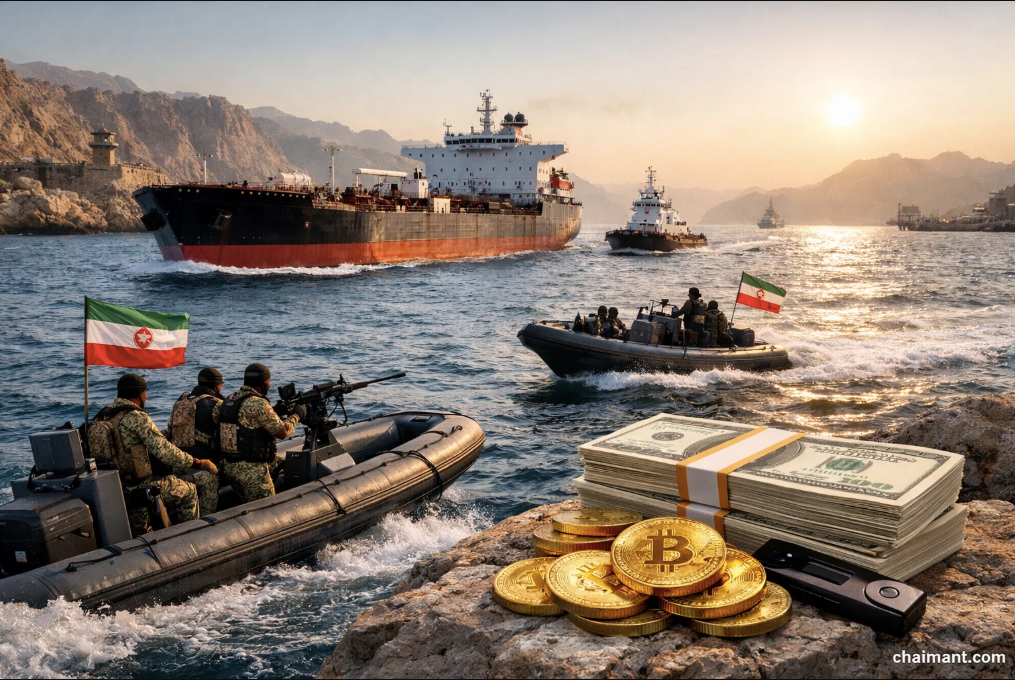



- Iran is charging oil tankers $1 per barrel in Bitcoin to transit the Strait of Hormuz, with the largest ships facing fees of up to $3 million per crossing.
- New regulations reduce daily ship transits from 135 to just 10–15, threatening a major disruption to global oil supply chains.
- Bitcoin was chosen specifically because it bypasses Western-controlled financial systems and cannot be sanctioned or confiscated.
One of the world’s most critical oil shipping lanes just got a cryptocurrency price tag. Iran is now demanding Bitcoin payments from oil tankers seeking passage through the Strait of Hormuz — a move that blends geopolitical leverage with crypto’s most attractive feature for sanctioned states: untraceability.
The Toll System, Explained
The mechanics are as blunt as the message. Shipping companies must first email Iranian authorities with full cargo details before approaching the strait. The fee is set at $1 per barrel of oil — meaning the largest crude tankers, carrying up to 3 million barrels, face a single-transit bill of $3 million in Bitcoin. Empty vessels are waved through free of charge.
Once a vessel is assessed and cleared, the window to pay is deliberately narrow — just seconds. Hamid Hosseini, a spokesperson for Iran’s Oil, Gas and Petrochemical Products Exporters’ Union, told the Financial Times this is intentional: Bitcoin ensures the funds cannot be “traced or confiscated.” Any ship attempting to pass without authorization, the spokesperson warned, “will be destroyed.”
Bitcoin was not chosen arbitrarily. It operates outside traditional banking systems, carries no national allegiance, and remains accessible despite international sanctions — making it the ideal financial instrument for a state operating outside Western-controlled payment infrastructure.
A Chokepoint Under New Rules
The Bitcoin toll is just one layer of a broader control framework Iran has imposed on the strait during a two-week ceasefire period. Ships must submit detailed cargo and vessel information in advance, undergo background checks, follow designated routes hugging Iran’s coastline, and receive final approval from Iran’s Supreme National Security Council — with no guarantee of passage and delays expected.
The cumulative effect on global shipping is severe. Martin Kelly, head of advisory at maritime intelligence group EOS Risk, estimates the new regulations will reduce transit to just 10 to 15 ships per day — down from the 135 ships that routinely passed through before the conflict. The Strait of Hormuz handles roughly 20% of the world’s oil supply. A bottleneck of this scale has direct implications for global energy markets and supply chains.
Also Read: Chainalysis: The $1.5 Quadrillion Stablecoin Era Is Closer Than You Think — Here’s Why?
What This Signals for Bitcoin — and Geopolitics
Iran’s decision to denominate a sovereign toll in Bitcoin is significant beyond the headlines. It marks one of the most direct uses of cryptocurrency as a geopolitical instrument by a nation-state — not for investment or retail adoption, but as operational financial infrastructure designed to evade Western oversight.
For the crypto industry, it is a double-edged moment. Bitcoin’s utility as a censorship-resistant, borderless payment system is validated at scale. But its use by a sanctioned government to enforce a militarised chokepoint is unlikely to be welcomed by those lobbying for cleaner regulatory narratives in Washington and Brussels.
The Strait of Hormuz has long been a pressure point in global energy politics. Now, for the first time, it has a Bitcoin address attached to it.
PS: This is a developing story.
UPDATE: ( 17th April 2026) Iran’s Bitcoin toll system at the Strait of Hormuz has drawn fresh scrutiny from energy analysts and crypto policy observers alike. Since the original report — first confirmed by the Financial Times via Hamid Hosseini of Iran’s Oil, Gas and Petrochemical Products Exporters’ Union, and followed up by Bloomberg as early as April 1 — shipping industry sources have confirmed that compliance costs are already being factored into freight pricing, with insurers reassessing risk models for Gulf-region routes. Blockchain analytics firm TRM Labs estimates the toll system could generate up to $20 million per day from oil tankers alone, while Chainalysis has warned that any shipping company making crypto payments to Iran risks severe U.S. sanctions penalties — a compliance minefield that remains largely unresolved. The 10–15 daily transit cap has yet to be formally lifted, and no major Western government has publicly outlined a coordinated response to the payment mechanism. Meanwhile, as Fortune and The Block have both noted, the episode has reignited debate over whether existing crypto regulatory frameworks are equipped to handle state-level sanctions evasion at scale. What began as a geopolitical toll story is quietly becoming a test case for how governments respond when Bitcoin stops being a speculative asset and starts functioning as sovereign financial infrastructure.
Disclaimer: The information in this article is for general purposes only and does not constitute financial advice. The author’s views are personal and may not reflect the views of chainrant.com/. Before making any investment decisions, you should always conduct your own research. chainrant.com/ is not responsible for any financial losses.